
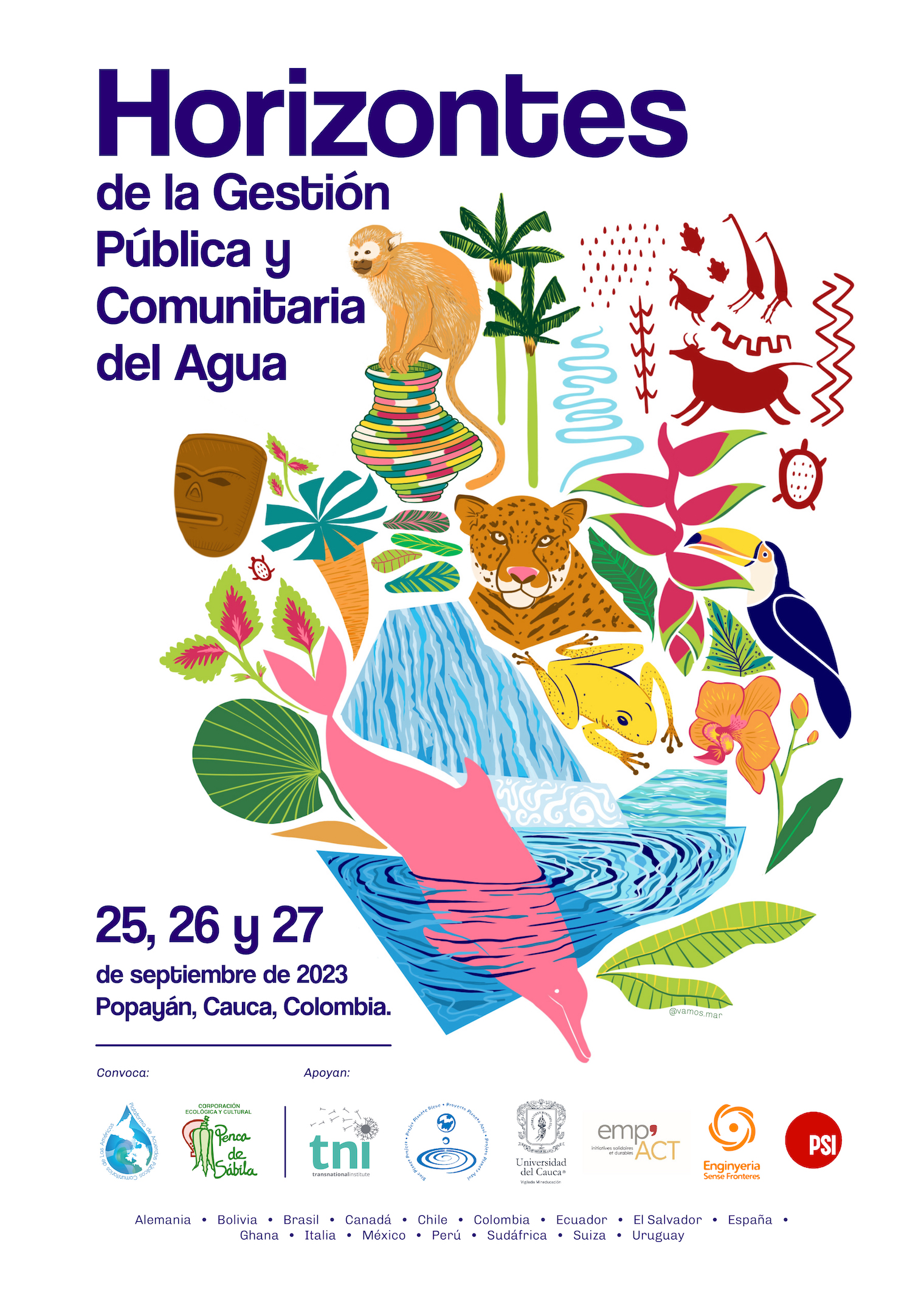
The Platform for Public and Community Partnerships of the Americas held the second Horizons of Public and Community Water Management Meeting from September 25-27, 2023, in Popayán, Colombia. This meeting of water defenders and movement from across the region and around the world was convened to share knowledge and experiences, gain new understandings of old and new strategies of water dispossession and privatization and organize to fight against them. The Blue Planet Project supported the organization of the Horizons Meeting and was present in Popayán for the proceedings. Read the Meeting’s closing statement, the Popayán Declaration, here.
Since it was founded in 2009, the Platform for Community Partnerships of the Americas (PAPC) has been working to promote and defend access to and supply of water as a common good and a fundamental human right. As a part of this work, the PAPC convened the first Horizons of Community Water Management Meeting in Medellin, Colombia in 2019.
Since this first meeting, threats to public and community water management grew amidst multiple and intensifying crises of Covid-19, conflict and climate. In this challenging context, the alternatives that public and community water operators and water justice movements have been building through our work—Blue Communities in Latin America, public-community partnerships and those between community and social organizations and unions, public policy and citizens’ legislative initiatives and constitutional developments—deserve recognition, exchange and comparative that enriches their deployment.
To give continuity to the challenges and alternatives explored at the first Horizons Meeting, the PAPC held a follow-up meeting in Horizons of Public and Community Water Management Meeting in Popayán, Colombia from September 25-27, 2023. This second meeting presented an opportunity to facilitate a dialogue between water movements and organizations that have historically focused on the dimension of public water management with networks and communities that build and defend community water management in their daily lives, welcoming participants from 15 countries across Latin America and around the world.
The conference opened with these diverse, global participants sharing their struggles for water justicel and water brought from each of their territories. Energized by our collective commitments, the conference moved to explore in more detail water struggles from across different regional and national contexts, with interventions speaking to both problems and obstacles as well as tactics, strategies and alternatives. The afternoon saw attention turn to workshopping feminist perspectives in water movements, engaging the construction of dominant and subaltern femininities, masculinities and the transformation of gender relations within and outside of water movements.
Day two of the Horizons Meeting began with the presentation of a Blue Communities Certificate to the Uivnersidade Católica Do Paraná (PUCPR), Brasil. Fr Elias Wolff accepted the certificate on behalf of the PUCPR from members of the Latin American and Blue Communities network, officially recognizing its status as a Blue University and Community. The presentation was followed by a session interrogating recent trends in water commodification and privatization focusing on financialization and the corporate and financial capture of the United Nation’s Sustainable Development Agenda and the UN 2023 Water Conference process.
This session led directly into two panels exploring contemporary threats to public and community water management and ongoing struggles including insights from across Latin America and similar struggles around the world. The second day closed with participants collectively working through movement processes of risk analysis and strategies to protect the water defenders who are on the frontlines of challenging these dynamics and incursions by private corporations and state institutions.
The third and final day of the Meeting emphasized alternatives. Beginning with community-community and public-community partnerships, participants shared and explored the dynamic and generative processes of cooperation and solidarity through which water movements and public and community operators around the world continue to deliver water to most of our planet’s inhabitants and protect and defend water services and resources from state austerity and private corporations and finance. An important topic on the agenda was the consideration of citizen legislative initiatives to protect public and community water services, which drew on experiences from across the Latin American region and Europe. This was an exciting opportunity to reflect on the National Network of Community Aqueducts of Colombia’s advocacy around the bill currently before the Colombian Congress to recognize community water management in the country, emphasizing the importance of recognition and the allocation of resources towards community water systems while simultaneously carefully ensuring their autonomy. The presence of a large international delegation from outside the region, with representatives from Africa, Europe and North America, itself constituted a significant show of support for the bill and the RED National’s work.
These discussions of solidarity, partnership and alternatives then zoomed out to the regional and global scales. The strong presence of international participants was an especially welcome opportunity to strengthen ties between organizational processes of community water management in Latin America and around the world. Together, participants first explored the important work of Blue Communities, the numbers of which continue to grow across the world, facilitating cooperation between communities, including schools, universities like the PUCPR, and faith-based organizations in addition to municipalities, to protect public and community water systems, advance the recognition and fulfillment of the human right to water and stand against privatization. The discussion then turned to an update and discussion of the People’s Water Forum, and its work on the global scale to protect and defend public and community water services and ecologies around the world from global water governance institutions, powerful states and private water corporations. Conversations included planning to challenge the upcoming World Water Forum to be held in Bali, Indonesiain 2024.
An inspiring and motivating engagement with water defenders and movements from across Latin America and around the world, the Second Horizons of Public and Community Water Management Meeting wrapped up with the reading of the meeting’s collectively authored closing statement, the Popayán Declaration.
