
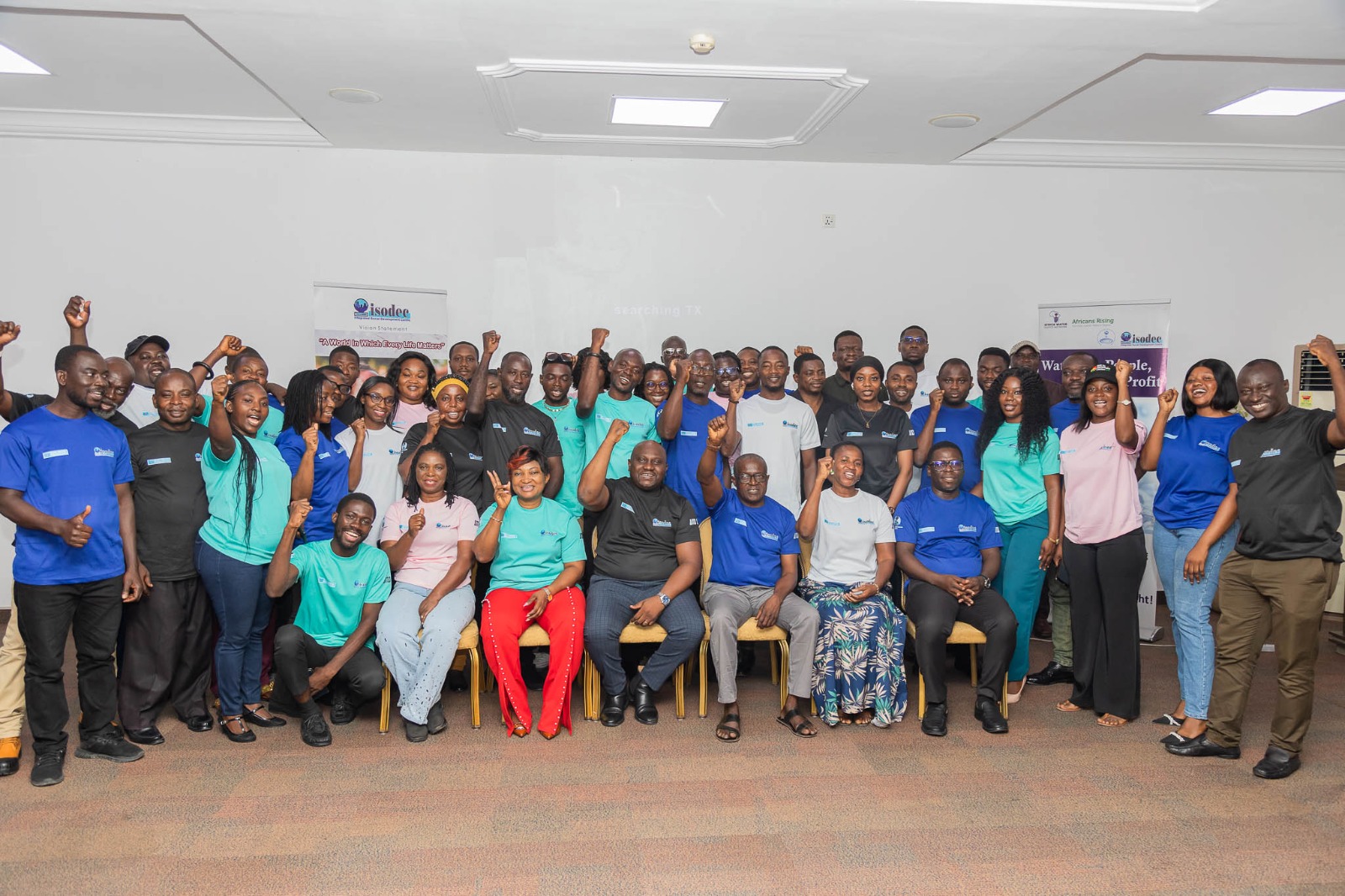
Accra, Ghana – At the launch of the Ghana Water Justice Campaign in Accra, the Blue Planet Project (BPP) and the Africa Water Justice Network (AWJN) joined civil society partners in calling for urgent action on water protection and justice, under the message: “We need higher commitment to address water issues.”
This campaign, supported by local civil society the Integrated Social Development Centre (ISODEC), is a shared initiative, bringing together Ghanaian water defenders with continental and global networks.

Leonard, a member of both the Blue Planet Project and the Africa Water Justice Network, said the government must invest more resources in the water sector to improve the well-being of its citizenry. A core goal of the campaign, to empower citizen’s voices and ensure access to clean and affordable water, reflected on ongoing challenges in the water sector including:
- Budget under-utilization: large gaps between what was budgeted and what was actually spent
- Rural infrastructure delays: projects lagging far behind schedule
- Galamsey pollution: illegal gold mining contaminating rivers and water sources
- Poorer water quality: putting communities at risk
- High tariffs and prepaid meters: creating barriers and risk of exclusion

Key to these issues highlighted was improper investment in the water sector, which could help resolve issues of health related diseases, disruptions on education and daily life, and the treatment of water as a commodity, not a right.
A core goal of the campaign is therefore to empower citizens’ voices and ensure access to clean, affordable water for all Ghanaians.


Mr. Samson Danse, executive director of the ISODEC, said the campaign had initially launched in 2004 but there was a need to sustain the initiative to ensure duty bearers played their role efficiently.
The campaign calls on civil society to follow these three threads:
Follow the Money. This means tracking delays in project funding and execution, keeping an eye on abandoned water infrastructure projects, and exposing budget gaps for rural water.
Follow the Water. This means demanding accountability for water losses, pushing for public water quality reports including turbidity and contamination levels, and monitoring pollution levels in major river basins.
Follow the Power. This means watching for policy recognition of community ownership models, questioning the expansion of prepaid water meters, examining tariff impacts on low-income households, and holding the CWSA and Water Resources Commission accountable for their performance.

The campaign launch set forth a series of recommendations, including key operations, policy and environment, and government and rights based approaches:
- Release budgeted water funds faster
- Cut water losses from 50% to a fair level
- Install fair meters rather than prepaid shut-offs
- Build rural water systems without delay
Protect water bodies
- Establish Water Protection Zones
- Integrate catchment protection plans into Spatial Planning Schemes
Combat galamsey (illegal gold mining)
- Seize assets of financiers and equipment owners
- Prosecute financiers and operators
- Deploy community-based river guards
- Use satellite and drone surveillance systems
Regulate boreholes
- Create a national borehole drilling permit system
- Establish a central groundwater database
- Promote shared community borehole systems
Water quality
- Upgrade treatment plants with advanced filtration
- Publish public disclosure of water quality compliance audits
- Rehabilitate water distribution networks
- Prioritize rural water – introduce a new concept of rural water provision
- Support community management – community-led systems backed by District Assemblies (DAs)
- Enable citizen participation – through decentralized, predictable platforms
The launch of the Ghana Water Justice Campaign is keeping the fight alive for public, community-led water, for clean and affordable access, and to protect water as a right, not a commodity.